
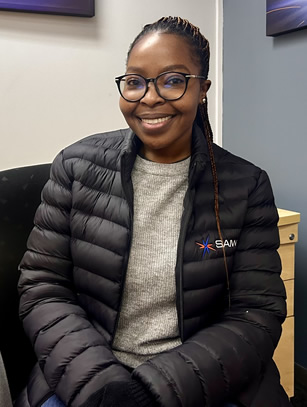
 Nozipho Sibambo has always approached her career with a strong sense of purpose. Ambitious, diligent and determined to keep moving forward, she may not have known from the outset that her path would lead from metallurgy and materials testing into the welding industry, but she has consistently known what she wanted from her career: to learn, to grow and to make the most of every opportunity.
Today, as Quality Coordinator at the Southern African Institute of Welding (SAIW), that mindset has helped her build a strong technical career while establishing her place in industries where women are increasingly making their mark.
Born and raised in Matsulu, between Mbombela and Malelane in Mpumalanga, Sibambo was drawn to science from an early age. Physics and chemistry were particular strengths, while mining was also familiar territory in a region where generations of families had built their livelihoods around the industry.
Interestingly, she gave little thought to the fact that mining was predominantly male. “The fact that I was a woman did not come into my mind,” she recalls. “I didn’t think that it would be a disadvantage for me to go work in the mine.” Her focus was on pursuing a scientific career and experiencing life beyond the environment in which she had grown up.
Her original intention was to study mining engineering at the University of Johannesburg (UJ), but when she arrived with her final matric results, the programme was full. A chance encounter with a university staff member led instead to an opportunity in engineering metallurgy, a discipline she knew little about at the time.
It proved to be a defining change of direction. Sibambo developed a particular interest in physical metallurgy, achieving a distinction in the subject before graduating in early 2019 and pursuing a BTech in the field. She has since developed a wonderfully simple description of her discipline: a physical metallurgist, she says, is essentially “a doctor for metals.”
Building technical depth
Sibambo’s early career was grounded in materials testing, where she spent close to five years developing practical technical experience. Laboratory work required her to understand not only the properties of different materials, but also their manufacturing processes, applications and performance in service.
Her appetite for learning also led Sibambo to pursue a Master of Engineering (MEng) in Mechanical Engineering at Nelson Mandela University, which she completed while working and graduated from in April 2025. Her research, titled “Fatigue Life and Whip-Peen Process Parameter Influence as Applied to 21CrMoV5-7 Turbine Rotor Steel,” took her into a highly specialised field well beyond her original area of expertise.
It required her to master new mechanical engineering concepts, terminology, methodologies and equipment, while integrating her existing knowledge of metallurgy and materials engineering. Bridging those disciplines strengthened her research, analytical and problem-solving abilities and, importantly, reinforced a pattern that has defined her career: a willingness to move beyond what she already knows in order to develop the expertise a new challenge demands.
After relocating to Johannesburg, she moved into senior quality control within a production environment and later became involved in overseeing a plant and implementing ISO-based quality management systems. Each role broadened her experience but also reinforced the importance she places on professional development. When she reached a point where she could no longer see sufficient scope for growth, she resigned and reconsidered her next move.
It was during this period that she encountered an opportunity at the SAIW. Although materials testing had exposed her to welds and weld defects, she had not previously worked directly in the welding industry. The laboratory technician position therefore represented an opportunity to enter a new technical environment and expand her expertise.
For Sibambo, the opportunity to learn outweighed considerations around job title. “I knew what I was going for, and I believed in myself,” she says. “If there’s growth, I’m going to grow there.” She joined the SAIW in February 2025 and has since progressed to Quality Coordinator.
Establishing credibility
While Sibambo did not initially view her career through the lens of gender, professional experience made her more conscious of the different expectations women can encounter in technical environments. These are not necessarily obvious barriers, she says, but often emerge through assumptions about capability and technical competence.
“You are expected to perform on a higher level. You are expected to prove yourself constantly.” She has encountered colleagues who questioned whether she could perform a physical task or assumed technical concepts needed to be explained from first principles.
Her response has been constructive. Rather than allowing those assumptions to distract her, Sibambo focuses on building knowledge and demonstrating capability. She also recognises that an unnecessary explanation may still contain useful information. “It’s my understanding versus the understanding that you give me,” she explains. “So now I have double the understanding.”
Women supporting women
Mentorship has also been important. Sibambo identifies former Nelson Mandela University supervisor Liezl Matthews as a significant influence during the formative stages of her career, particularly in the way she approached and analysed technical problems.
Matthews was also willing to share the professional judgement she had accumulated through experience. For Sibambo, learning from a more experienced woman demonstrated the value of mentorship in helping younger professionals
As South Africa marks Women’s Month, Sibambo believes meaningful progress has been made in the representation of women across technical sectors. Within welding, she sees women entering not only professional roles, but practical welding and workshop environments traditionally associated with men. Similar changes are visible in mining and engineering.
For Sibambo, greater visibility helps change perceptions of where women belong. The more commonplace it becomes to see women welding, working in laboratories, managing quality systems or building careers in metallurgy and engineering, the less gender needs to define conversations about technical capability.
Her own career provides a fitting example. The young woman who left Matsulu intending to become a mining engineer could not have predicted that an unexpected opportunity in metallurgy would eventually lead her through materials testing, advanced interdisciplinary research and quality management to the SAIW. What has remained consistent is her determination to keep learning, embrace unfamiliar territory and turn each new challenge into an opportunity for professional growth.